
A Cuban link chain looks simple from a distance: a continuous row of smooth, closely connected links. Up close, however, its character comes from precision. Every link has to follow the same shape, angle and spacing for the chain to lie flat and move naturally.
That is why people searching for how Cuban link chains are made often discover that the process involves much more than connecting metal loops. Forming, cutting, joining, twisting, shaping, polishing and quality control all influence the final appearance.
The exact manufacturing method varies between workshops and materials, but the basic principles remain similar. Stainless steel is especially practical for modern jewelry because its corrosion resistance comes from a protective chromium-rich surface layer; grade selection and finishing still matter when producing pieces intended for frequent wear. The Nickel Institute’s stainless steel overview explains why stainless steels are widely valued for corrosion resistance and versatility.
Step 1: Choosing the Metal
Every Cuban chain begins with the material.
Traditional luxury versions may use solid gold, while modern fashion jewelry frequently uses stainless steel for its strength, clean appearance and practical maintenance. ChainsHouse uses 316L stainless steel in many Miami Cuban designs, with silver, gold-plated and black finishes available depending on the style.
For a stainless steel cuban link chain, the quality of the starting material matters because the metal must tolerate bending, shaping and polishing without making the links feel flimsy.
At ChainsHouse, material choice is only the beginning. The finished chain is expected to feel substantial, sit comfortably against the body and maintain a consistent appearance from link to link.
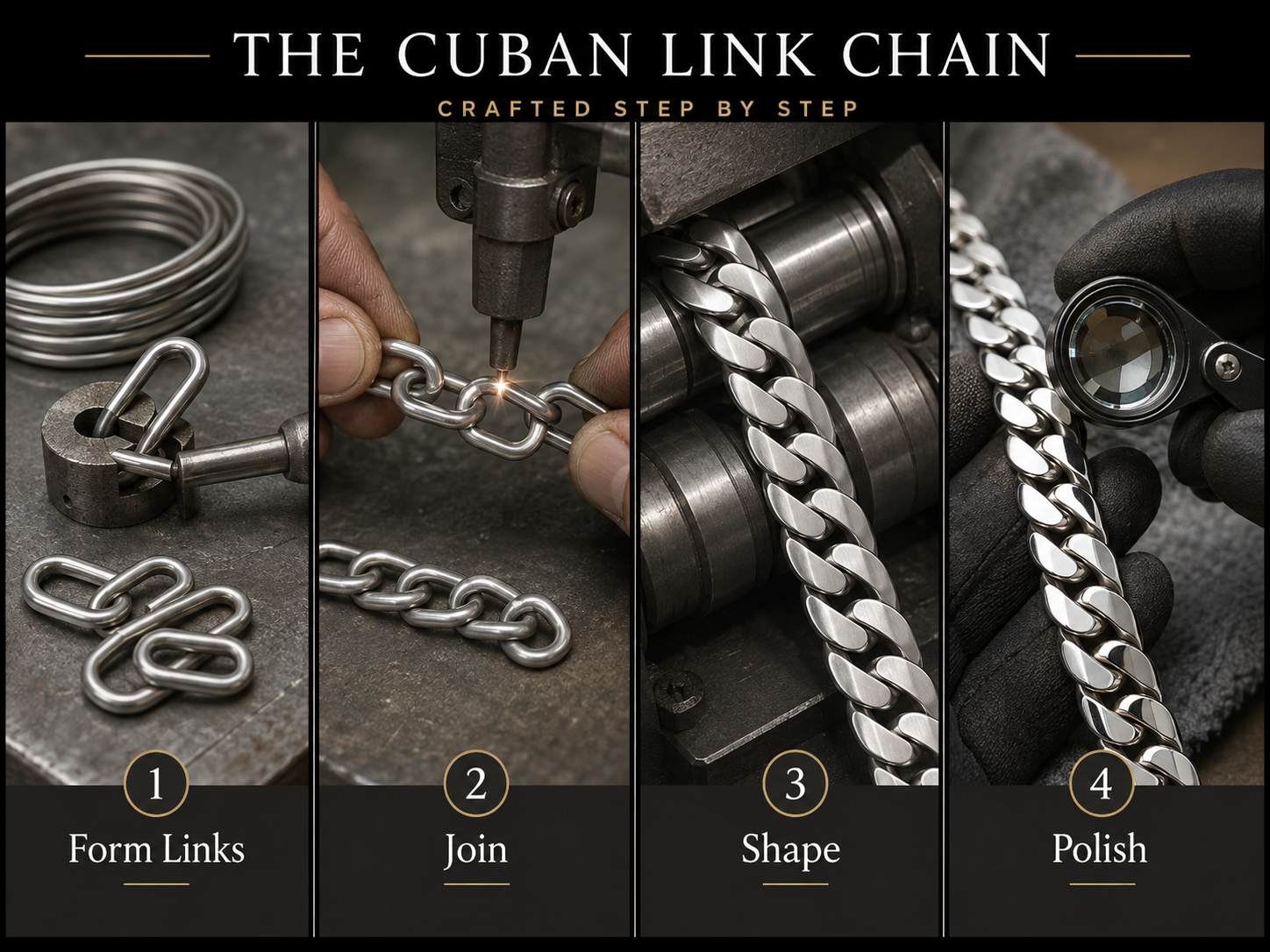
Step 2: Forming the Basic Links
The next stage is creating the individual links.
Metal wire or rod is formed into a repeated curved shape, traditionally by wrapping it around a mandrel or using dedicated forming machinery. The resulting coil is then separated into individual links.
Consistency is critical. If some loops are wider, thinner or more oval than others, the finished chain will twist unevenly.
The links are then interconnected one by one in a continuous sequence. At this stage, the structure still looks closer to an ordinary curb-style chain than the dense Cuban profile most people recognize.
This underlying construction is what allows cuban chains to appear in many different widths—from relatively slim everyday pieces to oversized Miami Cuban styles exceeding 10mm. ChainsHouse currently offers Cuban designs across necklaces, bracelets, rings and even anklets.
Step 3: Closing and Securing Each Link
Once the links have been assembled, their openings need to be secured.
Depending on the material and manufacturing method, links may be welded or otherwise permanently closed. This stage is essential because a Cuban chain is only as reliable as its weakest connection.
After joining, excess material around the seam has to be refined. Uneven joints would become obvious after polishing and could interrupt the smooth visual rhythm of the necklace.
For a good chain, you should not immediately notice where each individual link was closed.
This is also where quality expectations become practical rather than purely visual: the links should feel secure while still moving freely against one another.
Step 4: Twisting the Chain Into Its Cuban Shape
This is the stage that gives the Cuban link its recognizable personality.
The connected chain is twisted so the oval links begin to align in the same direction. Rather than sitting randomly, they gradually form the dense, repeating pattern that allows the necklace to lie flatter against the neck or chest.
The amount of twisting influences the final look. A tight Miami Cuban tends to appear dense and substantial, while looser curb-inspired chains can feel flatter and lighter.
Not every related chain uses exactly the same rhythm. A cuban figaro chain, for example, combines Cuban-inspired link construction with the Figaro pattern of alternating link sizes. ChainsHouse currently offers this hybrid design in widths from 4mm to 13mm.
Step 5: Flattening, Shaping and Calibrating the Links
After twisting, the chain needs to be shaped.
The links are pressed, rolled or mechanically adjusted so that their surfaces align and the entire chain sits smoothly. This step affects thickness, width and how much light reflects from each link.
For a 5mm chain, small dimensional differences may be difficult to notice individually but become obvious across twenty inches of repeating links.
For a 10mm or 14mm Cuban, precision becomes even more visible because each link has a much larger polished surface.
This is one reason width should not simply be treated as a style specification. Larger links expose more of the craftsmanship.
Step 6: Grinding and Polishing
Raw metal links do not automatically have the high-shine appearance associated with Cuban jewelry.
The chain goes through surface finishing to smooth rough edges, remove marks from forming and joining, and develop a more consistent reflective finish.
Polishing is particularly important for a Cuban link because its broad surfaces are part of the design. Light should travel smoothly across the chain rather than stopping at rough areas or inconsistent angles.
ChainsHouse describes its Miami Cuban designs as using closely woven links and precision-cut surfaces to create sharper edges and stronger shine.
This finishing stage is also what gives a chunky cuban link necklace its strong visual impact. The 10mm ChainsHouse version uses polished stainless steel and is designed as a standalone statement chain or a heavier layering piece.
Step 7: Applying Color or Surface Finishes
A silver-tone chain may retain the natural stainless steel appearance, while gold and black designs require additional finishing.
Depending on the product, a coating or plating system is applied over the underlying metal to create the final color.
This is why care still matters even when the base metal is durable. Harsh chemicals and abrasive surfaces can gradually affect decorative finishes.
Stainless steel itself is corrosion resistant, but industry guidance notes that aggressive chloride environments can still cause localized corrosion under certain conditions.
For everyday jewelry, gentle cleaning and proper drying remain good habits.
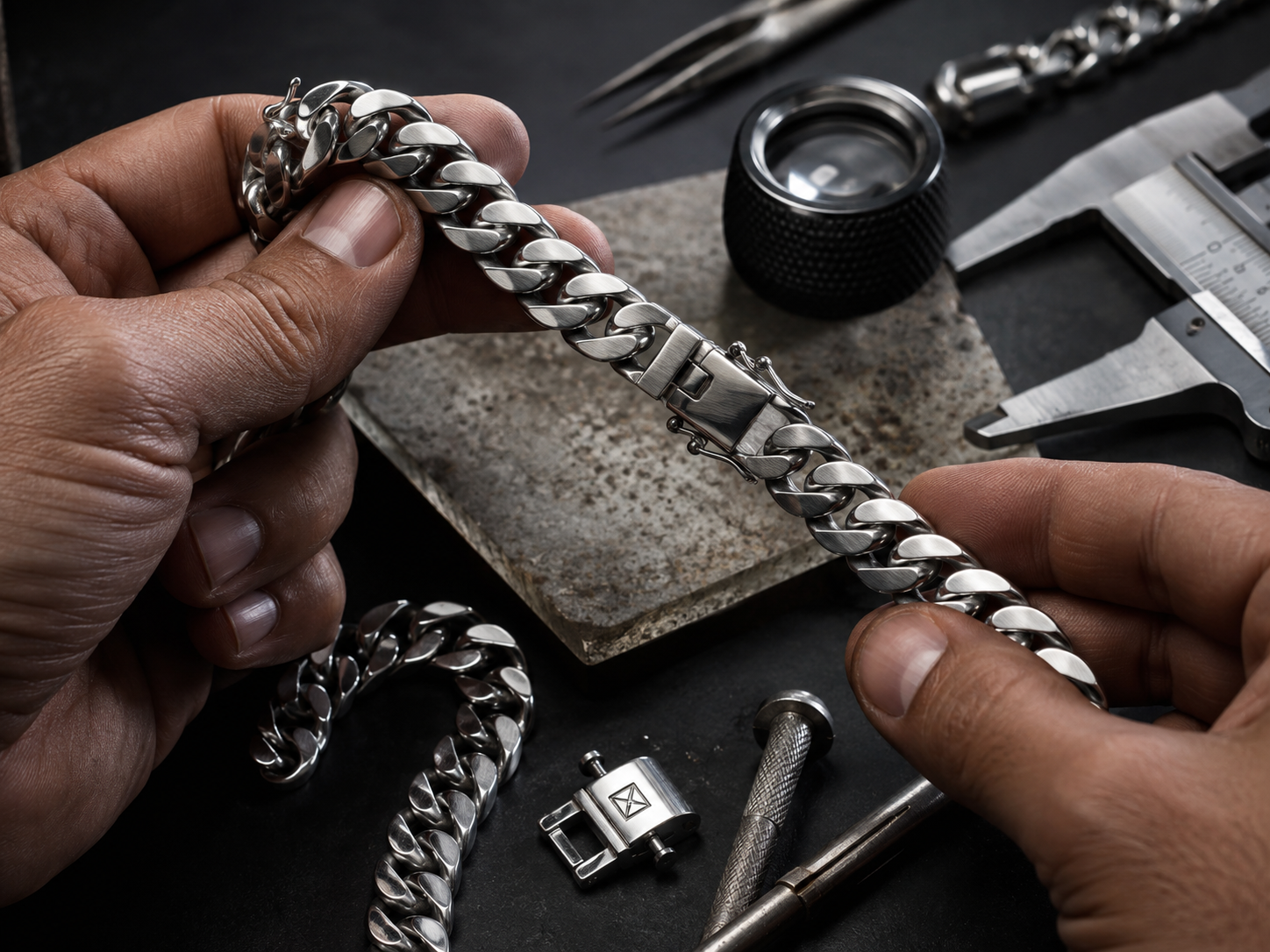
Step 8: Adding the Clasp and Performing Quality Checks
A chain is not finished when the links look good.
The clasp, end pieces and connecting components must also be secure. ChainsHouse Cuban necklaces use different clasp systems depending on the design, including lobster and fold-over clasps.
Before a piece is ready to wear, key points should be checked:
| Quality Point | What to Look For |
|---|---|
| Link consistency | Similar shape and spacing across the chain |
| Movement | Links flex smoothly without catching |
| Surface finish | Even polish without sharp edges |
| Alignment | Chain lies naturally rather than twisting |
| Clasp | Secure opening and closing |
| Overall feel | Balanced weight and comfortable contact |
These details matter whether the same construction becomes a necklace, bracelet or cuban link anklet. ChainsHouse’s sterling silver Cuban anklet, for example, translates the link concept into a lighter 8.7-inch adjustable design rather than simply shrinking a heavy necklace.
What ChainsHouse Looks for in a Cuban Chain
For ChainsHouse, a good Cuban chain should balance three things: visual impact, durability and everyday wearability.
The brand focuses heavily on stainless steel chain jewelry and describes its pieces around strong materials, polishing, hypoallergenic wear and practical everyday use.
A chain should look bold without feeling unfinished. Links should remain visually consistent. Polished surfaces should reinforce the shape rather than hide flaws. Width and length options should also allow the same design language to work for both restrained and statement styling.
If you want to understand the design after seeing how it is made, read ChainsHouse’s What Is a Cuban Link Chain? History & Style Guide, which explains how the structure evolved into one of the most recognizable chain styles in contemporary jewelry.
A Cuban chain may be built from repeated links, but the finished result depends on how carefully every one of those repetitions is executed.
FAQ
1. How is a Cuban link chain made?
Individual metal links are formed, connected, secured, twisted into alignment, shaped, polished and fitted with a clasp.
2. Are Cuban link chains handmade or machine-made?
Both methods exist, and many modern chains combine machine forming with additional assembly, finishing and inspection.
3. Why do Cuban chains lie flat?
Their interlocking links are twisted and shaped into a consistent orientation that lets the chain sit closely against the body.
4. Is 316L stainless steel good for Cuban chains?
316L stainless steel offers useful corrosion resistance, toughness and finishing properties for frequently worn chain jewelry.
5. Why are thicker Cuban chains more expensive?
Wider chains require more material and make link consistency, shaping and surface finishing increasingly important.
